Demystifying 5G NR Transmitter Testing: Power Spectrum, Spectral Flatness & EVM(Constellation Error)
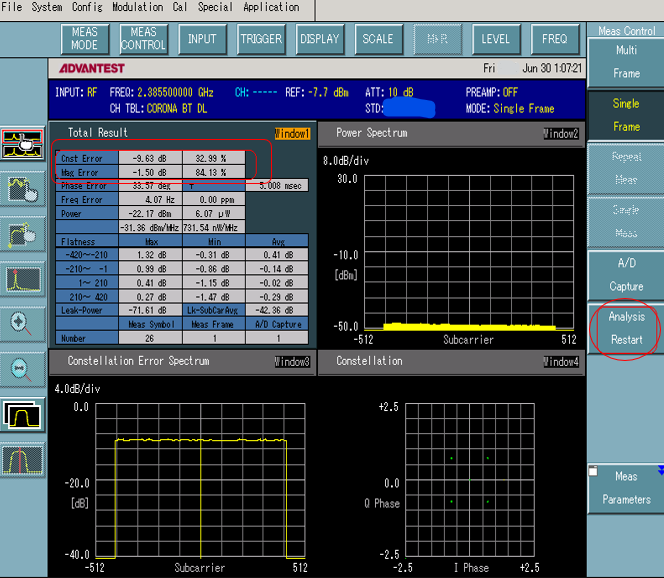
Advantest Spectrum Analyzer for Constellation Error, Spectral Flatness & Power Spectrum
This Error Vector Magnitude test evaluates how clean and accurate the radio’s transmitted signal is. When the signal becomes distorted, devices have a harder time decoding it. Lab Engineers run this test to confirm that the radio unit(5G RU) is performing as desired and meets required 5G quality standards.
1. Validate 5G NR Modulation Quality
5G uses advanced modulation schemes (QPSK, 16‑QAM, 64‑QAM, 256QAM). If the radio distorts the signal, the phone cannot decode it correctly.
EVM tells professionals whether the RU is good enough to support high‑speed data.
2. Ensure the Power Amplifier Is Not Distorting
When the PA is driven too hard, it introduces noise and distortion. This validation shows whether the PA is operating within safe limits.
3. Confirm Compliance With 3GPP Standards
Every radio must meet strict limits for:
EVM
Frequency error
Phase error
Power accuracy
This test verifies that the RU passes certification requirements.
4. Detect Hardware Problems Early
Undesired EVM can indicate:
Faulty PA
Damaged RF chain
Calibration issues
LO phase noise
IQ imbalance
This test empowers technical team to trace issues before deployment.
5. Validate Manufacturing Quality
Every RU manufactured undergoes this test to ensure:
No defective components
No assembly errors
No calibration drift
6. Constellation Diagram (top right)
This is a picture of the radio signal’s modulation quality. Each dot represents a symbol the radio is transmitting.
If the dots are tight and clustered → good signal If the dots are everywhere or spread out → poor/worse signal
7. Power Spectrum (top right)
This shows how the signal’s power is distributed across frequencies. It helps testers visualize whether the radio is transmitting in the correct channel and whether unwanted noise is leaking outside the band.
8. Constellation Error / EVM (left side)
This is the most important part of the test.
The red‑boxed value “Constellation Error” (also known as EVM – Error Vector Magnitude) tells you how distorted the signal is.
Lower EVM → cleaner signal Higher EVM → worse/Poor signal
